Pendulum: practice and limits
A look at pendulum practice as an observation exercise, without using its movement as a diagnosis or certainty about external events.
A movement may catch your attention without being a reliable answer. This guide suggests distinguishing observation, expectation, and interpretation, and keeping decisions that need evidence or professional support outside the practice.
These texts are under editorial review. Their references and content will be checked before they are published as approved guides.
Chamanismo y Holística Editorial Team · October 7, 2026
A tool for attention
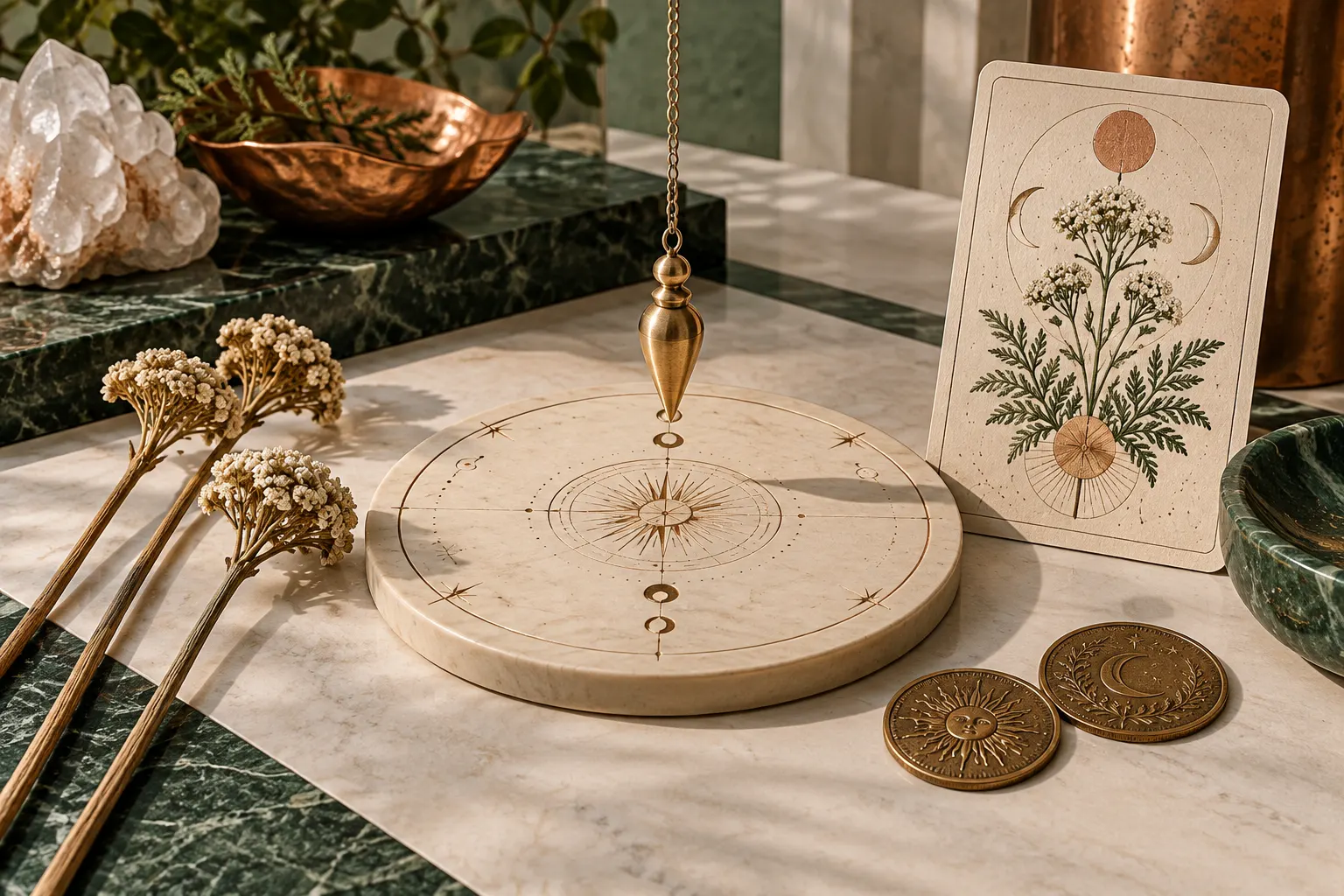
A pendulum is a weight hanging from a thread or chain. The person using it holds it in their hand, asks a question, and observes its movement. In this guide, we treat it as what it can best be: an exercise in attention and conversation with yourself.
It doesn’t need to be made of a special material. A ring on a thread or a small nut works just as well for practice.
What psychology says
Pendulum movement is well explained by the ideomotor effect: small, involuntary muscle movements we make when thinking in a particular direction. William Carpenter proposed the term in 1852. Experiments in the 19th century pointed in the same direction: in 1833, Michel Chevreul observed that the movement stopped when a person became aware of it, and in 1853, Michael Faraday designed an apparatus with cards that showed the hand moving before the table.
That doesn’t make it any less useful as an exercise: the pendulum can make preferences or doubts you already had more visible. But it also can’t confirm that it knows external answers or detects energies.
How to practice
Sit with your elbow resting on a table and hold the thread between your thumb and index finger. Wait for the pendulum to become still. Decide for yourself which movement represents “yes,” “no,” and “I don’t know,” for example: back and forth, left and right, and a circle.
Start with questions you already know the answers to, so you can observe how your own body responds. Then try questions about preferences: “Does this option make me feel at ease?” Change the topic and notice whether the intention with which you hold the thread changes.
A simple experiment to understand it
Try this. Hold the pendulum and focus intently on a circular movement, without deliberately moving your hand. It will often start to swing. Now close your eyes and ask someone else to change the direction you imagine, without telling you; you’ll notice how the movement follows your expectation.
This exercise is not about demystifying anything; it is about learning how your body participates in the response. That awareness makes the practice more honest.
Which questions are best avoided
Don’t use it to make decisions about health, money, or safety. Don’t use it to ask about other people, either. Use it to sort through your own preferences: “Does this option give me peace of mind?” is a question about you. Avoid asking repeatedly until you get the answer you want: if you do, you’ve already answered it yourself.
Illustrative example
As a made-up example: a person is unsure between two times to start studying. They ask the pendulum about each one and notice that, when they consider the morning time, they feel a sense of relief they hadn’t named before. They don’t let the pendulum make the decision: they use it as a prompt to listen to themselves, and commit to trying mornings for a week and evaluating how they feel.
Closing
Note what you noticed, not just what moved: the emotion, the body, the doubt. The value of the exercise lies in the conversation it opens with you, not in the certainty it promises. If you realize you’re consulting it anxiously about everything, it’s a good time to pause and talk with someone you trust.
Materials and how to choose a pendulum
You can use a store-bought pendulum made of metal, wood, or stone, or improvise with a thread and a small weight. Choose one that feels comfortable: not too light, since it will move with any air current, and not too heavy, since your hand may tire. A thread about twenty centimeters long is usually a good starting point.
You don’t need to “charge” or “cleanse” the pendulum to practice. If you enjoy a small starting ritual, such as washing your hands or taking three breaths, make it your signal that a time for paying attention is beginning.
How to reduce your own biases
Since the movement comes from your own hand, it helps to practice honestly. Write down the question before you begin, define what each movement means, and record the answer without reinterpreting it afterward. If you don’t like the answer, don’t repeat the question: ask yourself why you don’t like it, which is usually a more interesting question.
A good test is to ask the same question on two different days without remembering the previous answer. If it changes, that’s a clue that the pendulum reflects your state in the moment—and that’s valuable information about yourself, too.
Frequently asked questions
Does it work if I don’t believe in it? The ideomotor effect occurs whether or not you believe, although your attitude influences what you ask. Can I use it to find objects or people? There’s no basis for that: don’t use it for important decisions. How much should I practice? Ten minutes now and then is enough; if you notice yourself relying on it to make decisions, that’s a good sign to take a break from it for a while.
Taking it into your journal
If you want the practice to be useful beyond the moment, take two minutes to note three things: the question, the answer you observed, and what you felt in your body when you saw it. After a few weeks, reread your notes: you may discover which topics leave you with the most uncertainty, and that tells you more about yourself than any single movement.
Always end with a small action that depends on you. If the pendulum helped you notice that you prefer one option, the action could be to commit to trying it for a few days and evaluate how you feel.
Do not use the pendulum to replace a test, a conversation, or a professional assessment. If you choose to practice, keep these limits as part of the method.
Readings for comparison
- W. B. Carpenter, «On the influence of suggestion in modifying and directing muscular movement» (1852).
- Michael Faraday, “Experimental investigation of table-moving,” The Athenaeum (1853).
- Daniel M. Wegner, “The Illusion of Conscious Will” (2002).