Runes for beginners
A first introduction to the chosen system, its reading conventions, and a recording practice, with context and limitations.
Before looking for a meaning for each sign, it helps to know which system you’re using and what rules the practice follows. This guide offers a starting point without presenting current practices as a single, unchanging tradition.
These texts are under editorial review. Their references and content will be checked before they are published as approved guides.
Chamanismo y Holística Editorial Team · October 7, 2026
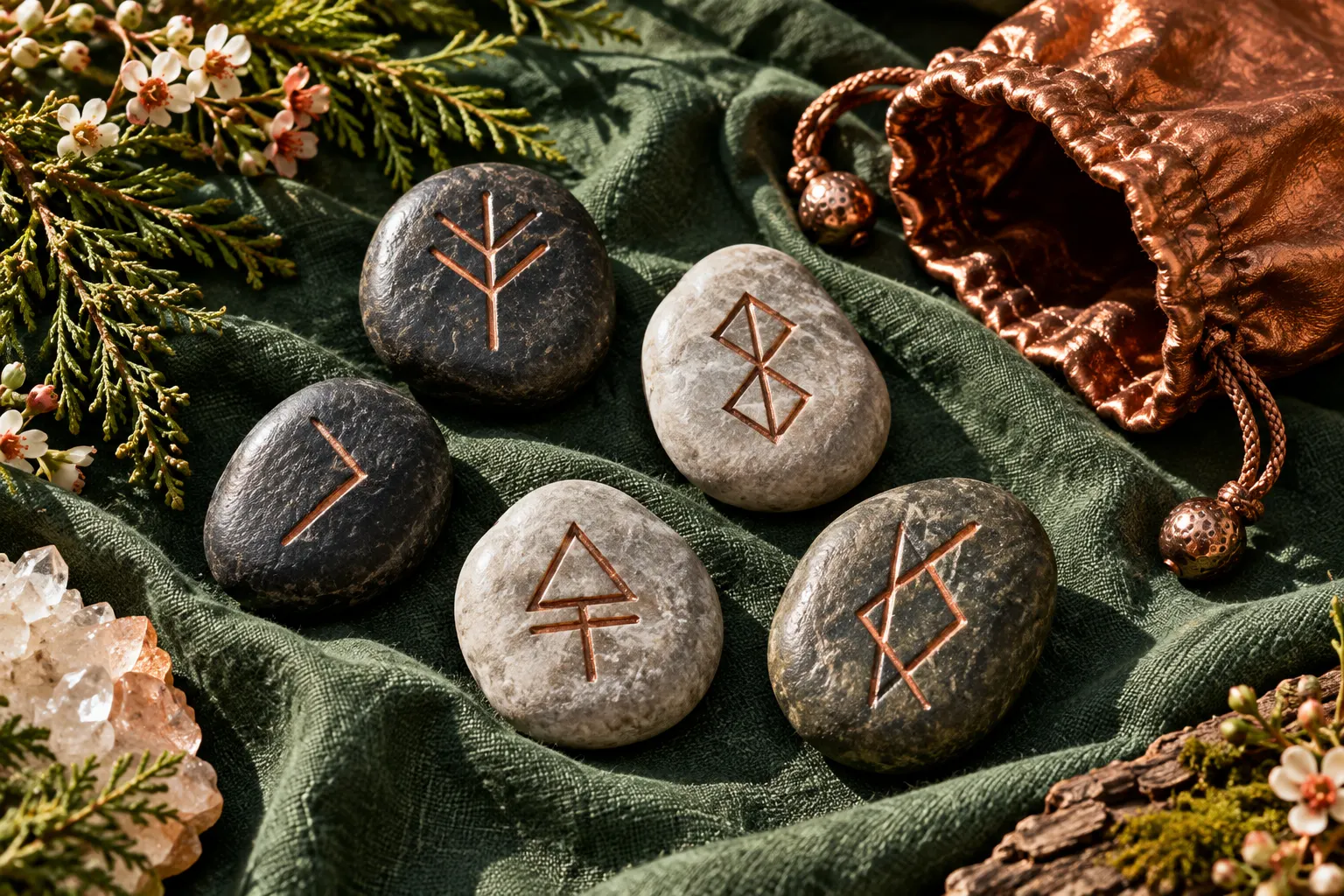
What runes are
Runes are the signs of alphabets used by Germanic peoples from the first centuries of the Common Era. The best-known set, the Elder Futhark, has 24 signs and is documented from the late second century to around the year 700. Its name comes from the first six runes: f, u, th, a, r, k.
Over time, variants appeared: the Anglo-Saxon futhark, with more signs, and the Scandinavian Younger Futhark, with only 16. When people talk about a “rune reading” today, they almost always mean the 24-sign Elder Futhark.
Three planes worth distinguishing
First, the historical plane: runes were a writing system used in inscriptions on stone, metal, and wood. Second, the modern tradition plane: since the 20th century, reading practices have attributed meanings to each sign, often drawing on medieval rune poems. Third, the personal plane: what each person finds through reflecting with them.
They are not the same. Medieval runic poems document names and brief verses for several runes, but there is no ancient source describing a system of divination with them as practiced today. Saying so honestly does not diminish the value of the practice; it puts it in its proper context.
How to get started
You can start with just one sign a day. Draw it calmly, name the idea it represents to you, and note a situation where that idea is present. Then consult a traditional meaning for contrast.
Learn a few signs in depth before expanding your repertoire. Meanings vary by author, so always keep track of which source you consulted to avoid mixing systems.
- Fehu: resources and their circulation.
- Raidho: path and pace.
- Gebo: exchange and reciprocity.
- Isa: pause and stillness.
- Berkano: growth and care.
Symmetrical and reversed runes
Of the 24 runes, nine are symmetrical, meaning they look the same when turned around: Gebo, Hagalaz, Nauthiz, Isa, Jera, Eihwaz, Sowilo, Ingwaz, and Dagaz. By modern convention, these are always read upright. The other fifteen can be read reversed, as a more tense or blocked version of the meaning.
This is a recent, non-universal convention. If you prefer to read all runes upright, do so and stick with that rule.
A three-rune spread
Ask an open-ended question, for example: “What do I need to notice to organize my priorities this week?” Draw three runes from a bag without looking and assign them positions: what is present, what needs attention, and a possible next step.
Read each rune separately, then read them together. Ask yourself what coherent story they form and which part of that story depends on you.
Illustrative example
As a made-up example to illustrate the method: a person draws Fehu, Isa, and Berkano. Fehu in the present speaks to them about resources and how they flow; Isa asks them to pause before spending energy on new decisions; Berkano as a possible next step suggests patiently caring for something that is beginning to grow.
Your personal reading might be: “I’m scattering my energy; I need to stop, set priorities, and protect a small project.” The action: choose a project, set a review date, and put off new decisions for a week. Notice that the reading is a mirror, not a prediction.
A responsible practice
Use the runes to ask better questions, not to expect definitive answers. Avoid attributing power to them over other people’s health, money, or relationships. Respect the cultural context they come from: they are not a decoration or a brand; they were the writing system of real peoples.
How to choose or make your set
A set of runes has 24 pieces, each with a symbol. You can buy one, but you can also make your own: small river stones, slices of a branch, or thick cardstock will work. Drawing each symbol by hand is a way to learn them, and the material matters less than the care you put into preparing it.
Keep the pieces in a bag that conceals the symbols so you can draw them without looking. If you use cardstock, make sure the pieces look the same on the back so there are no clues that could influence your choice.
How to read a spread: relationships between runes
When you read several runes together, notice how they respond to one another. Some reinforce each other, like Fehu (resources) and Gebo (exchange); others add nuance, like Uruz (strength) and Isa (pause). Don’t look for a fixed rule: ask yourself what conversation they’re having and what they’re telling you about your question.
If a rune appears in different spreads, note it in your journal. Sometimes patterns say more about your current concerns than about the runes themselves.
Frequently asked questions
Do I need to learn all 24 signs before I start? No: start with the five or six that appeal to you most, and add more at your own pace. How many times can I cast for the same question? Once. Repeating until you get the result you want turns the practice into a game of confirmation. Can I ask about someone else? It’s better not to: ask yourself what you need in relation to that situation.
Choose a method, record what you observe, and acknowledge its conventions. Understanding how you read matters as much as the association you make with a symbol.
Readings for comparison
- R. I. Page, «Runes» (British Museum Press, 1987).
- Ralph W. V. Elliott, «Runes: An Introduction» (1959).
- Medieval rune poems: Anglo-Saxon, Norwegian, and Icelandic (critical editions).