Tarot as a space for reflection
How to use a card to observe a situation, formulate questions, and record what you think without turning a spread into a prediction.
An image can help you find words for a concern. That doesn’t mean it knows more than you do about your life. This guide distinguishes the use of tarot from the certainties it can’t offer and suggests a simple writing practice.
These texts are under editorial review. Their references and content will be checked before they are published as approved guides.
Chamanismo y Holística Editorial Team · October 7, 2026
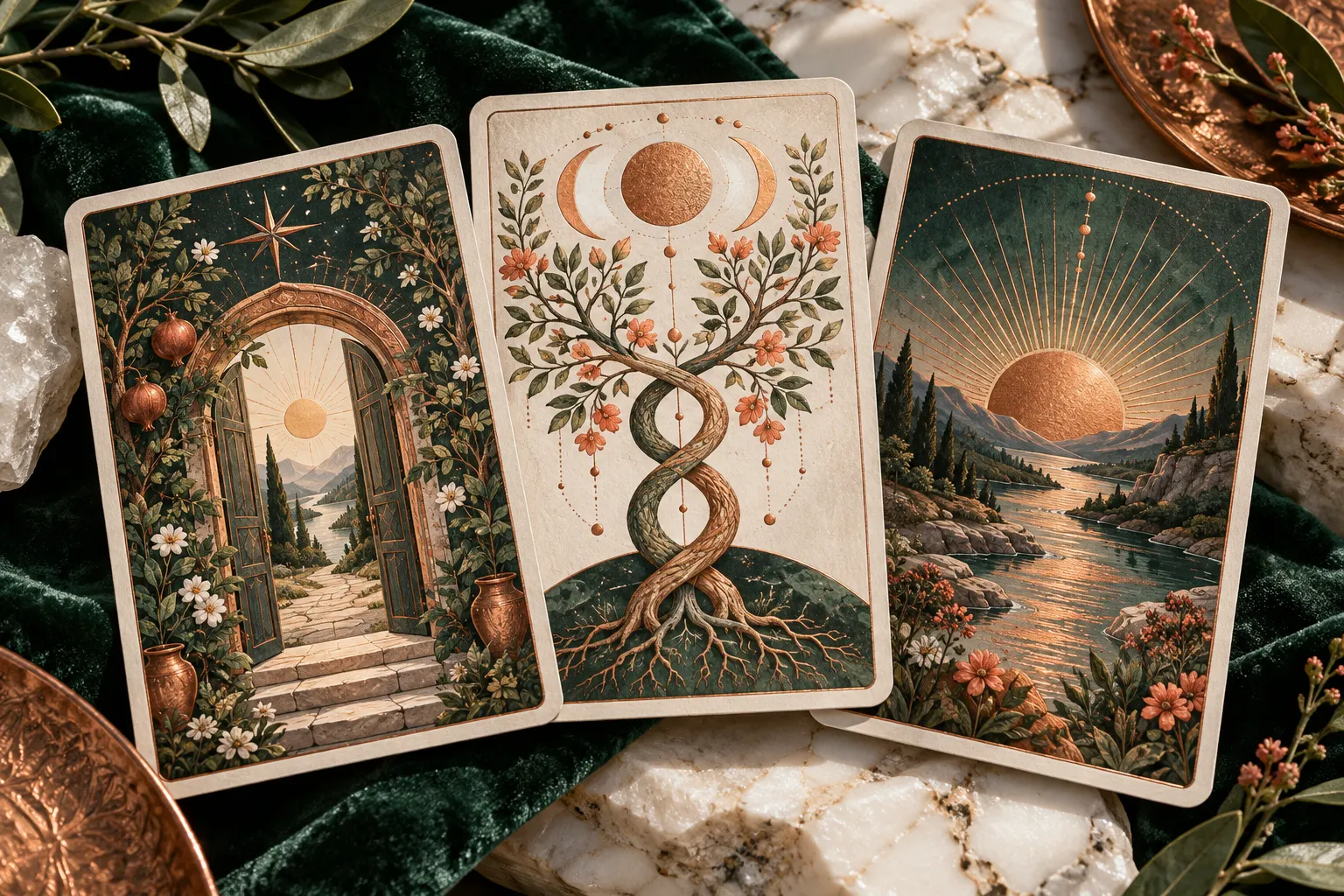
What is tarot and where does it come from?
A tarot deck has 78 cards: 22 major arcana, featuring figures such as The Magician or The Tower, and 56 minor arcana, divided into four suits (in this site’s Spanish tradition: Wands, Cups, Swords, and Coins) with cards numbered from Ace to Ten and four court figures: Page, Knight, Queen, and King.
Its documented origins are recreational. The first decks with trumps appeared in northern Italy in the 15th century as a card game. Divinatory and esoteric interpretations came later, starting in the 18th century, through authors such as Antoine Court de Gébelin, and became established in the English-speaking world with illustrated decks such as Rider-Waite-Smith, published in 1909 with illustrations by Pamela Colman Smith.
It’s worth saying clearly: there is no unbroken, millennia-old tradition of tarot, and there is no scientific evidence that cards predict events. Its value, when it has any, lies elsewhere.
Three ways to understand the cards
Some people experience them as a tradition worth studying in its own right, with its schools and interpretations. Others use them as a prompt for reflection: a random image that takes you out of your usual way of looking at something. And some combine them with their personal spirituality.
At Chamanismo y Holística, we take the second and third positions, and we say so transparently: tarot is a language of images for asking questions. It isn’t a method of prediction or a substitute for medical, legal, financial, or psychological advice.
Before we begin: space and question
Choose an unhurried moment and a clear surface. You don’t need an elaborate ritual: turning off notifications and taking a few breaths is enough to mark a shift in attention.
The question is the most important part. Open-ended questions work better than yes-or-no questions. Compare these two: «Will I get the promotion?» versus «What do I need to consider to decide whether this job change is right for me?». The first calls for an answer the card can’t give; the second puts you at the center of the decision.
- Avoid asking what someone else thinks or will do: you can't know, and the cards can't either.
- Avoid questions about health, pregnancy, or death: these are not suitable topics for tarot.
- Choose questions that begin with “what,” “how,” or “what for” and focus on you.
A one-card practice
Shuffle calmly and draw a card. Before looking up its meaning, observe for one minute: What detail in the image draws you in first? What emotion comes up? What part of your question does it touch?
Then consult the traditional meaning as a second voice alongside your own, not as the right answer. Note in your journal where it matches what you felt and what surprises you.
Finish with a small, realistic action for the next three days. A card isn’t valuable for what it supposedly announces, but for the conversation it opens with you.
A three-card spread
The three-card spread is the most commonly used starting point because it helps organize your thoughts. One simple way to assign positions is: what’s present, what needs attention, and one possible next step.
Read each card separately before reading them together. Ask yourself what coherent story they tell, which part of that story depends on you, and which part doesn’t. If a card makes you uncomfortable, don’t dismiss it: ask yourself what part of you is resisting.
Reversed cards: an option, not an obligation
Some people read reversed cards as a nuanced or tense version of their upright meaning; others disregard orientation entirely. Both approaches are valid. The important thing is to choose a rule before you begin and stick with it, so your method stays consistent.
A useful way to read a reversed card is to ask yourself: where is this theme getting stuck, being exaggerated, or being avoided?
Illustrative example
Imagine, as a fictional example to illustrate the method, someone asking: “What do I need to consider before deciding whether to change jobs?” They draw three cards: The Hermit (present), Five of Pentacles (attention), and Ace of Wands (possible step).
Reading the first one, she notices that she has been reflecting alone for some time. The second reminds her that concerns about resources are real and invites her to calculate how much room she has. The third suggests a drive to take initiative: perhaps the possible next step isn’t to quit, but to explore one concrete option for a week. The final action is simple: list her expenses for three months and talk with someone who has made a similar change.
Notice that none of this predicts outcomes: it organizes the inner conversation and ends with small actions that depend on the person.
Common issues
Repeating the same question until you get the card you hoped for; using tarot to avoid a decision; reading the cards as verdicts; consulting them in moments of great distress as if they were an authority. If you notice any of these patterns, taking a break or talking with someone you trust is often more helpful than another reading.
Limits
If a question involves health, an emotional crisis, violence, or a high-risk decision, a qualified person is the best source of support. Tarot can support your reflection, but it can’t resolve those situations.
Compare what you wrote with your experience and the information you need. An interpretation can open up a question; it doesn’t have to settle your decision.
Readings for comparison
- Michael Dummett, “The Game of Tarot” (1980).
- Michael Dummett, Ronald Decker, and Thierry Depaulis, “A Wicked Pack of Cards” (1996).
- Antoine Court de Gébelin, «Le Monde primitif» (1781), volume 8.